
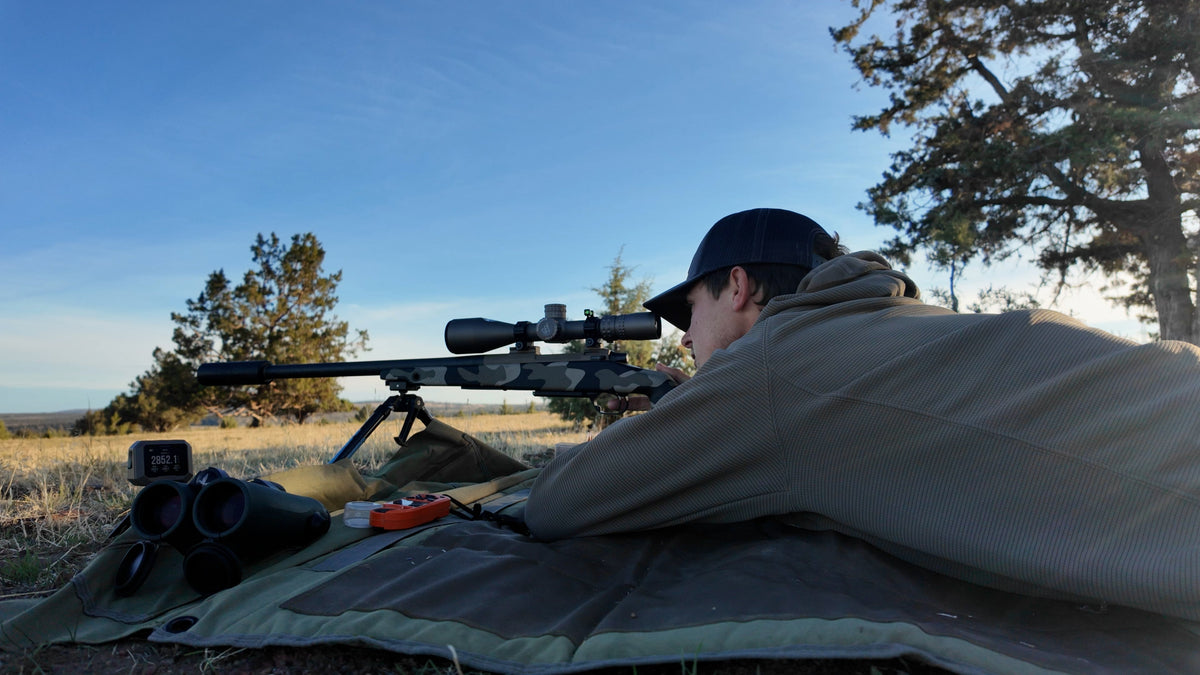
Ty is heading to Wyoming for a deer hunt on a tag he drew, and he's taking a brand new 7mm SAUM. In this video he walks through the routine he runs before every hunt, whether the rifle is brand new or has been in the safe for five years: confirm the zero, confirm the velocity, then stretch it out and make sure the numbers hold up at distance.
Why validate before every hunt
Once a rifle has been validated out to distance, Ty says only two things can change its downrange performance: your 100-yard zero and your velocity. A new lot of ammo, or handloads built on a new lot of powder, can both move your speed. A bump in transit can move your zero. Checking those two things is fast, and it tells you whether the rest of your data can still be trusted.
His line for why it matters: your ballistic solver has no feelings. If the rifle is actually three quarters of an inch to an inch and a half off at 100 yards, but you've told the solver you have a true 100-yard zero, the solver can't compensate for it. The miss gets bigger the farther out you shoot.
The routine, step by step
- Go to a spot you trust and check your 100. Ty has a place he goes before every hunt, whether it's public ground or a private ranch. He checks his 100-yard zero and reads velocity with a Garmin chronograph.
- On a clean barrel or a new rifle, don't judge it by one shot. Ty's first shot on the clean barrel hit high. By the third shot the barrel had fouled in and he was back on the bullseye. He shot a 3-shot group, let the rifle cool, and shot a second 3-shot group before deciding anything. If your point of impact hasn't shifted between the two groups, leave the scope alone. His rule of thumb is not to shoot one round and move the turret, because many rifles that people adjust were never off in the first place.
- Confirm velocity, then put it in the solver. His speed was consistent at around 2850 fps, and across the second group it varied by only about one foot per second. He entered 2850 into his Kestrel. If you change ammo lots, or powder lots on handloads, run it over the chronograph again.
- Cross-check your ballistics. Ty also ran a pair of Swarovski ballistic rangefinding binoculars with a built-in ballistics solver. At 612 yards the binoculars called for 11.66 MOA and his Kestrel gave 11.62, which he called spot on. He always rounds down, so he dialed 11.5.
- Set up the shot. He leans forward into the rifle to soak up flex and load the bipod, checks the bubble level on the rear rest, and clears up the scope picture before he breaks the shot.
- Watch your velocity downrange. At one point the chronograph read 2836 against the 2850 in his solver, so he kept the chronograph set up to watch for any change as the barrel heated up. He then held the left edge of the target, which is where the rifle hit.
- Range the target more than once. Before moving to the next target at 740 yards, he ranged it several times to make sure he wasn't ranging over or under. He let the barrel cool before the next shots.
- Account for wind, then confirm. At 740 yards he dialed 15.5 MOA. Wind was moving right to left, and he held straight up on the target, figuring that was about enough to offset spindrift. Two shots landed in a 2-inch orange dot, less than a couple of inches apart.
If the rifle is already validated
Ty's point is that once a rifle has been validated to distance, a clean 100-yard check and a velocity check are often all you need before a hunt, and you may not need to shoot downrange at all. He stretched it out here because it was a new rifle.
Keep in mind
These are the numbers from one rifle and one load on one day. Your velocity, zero, and dope will be different, so run the routine with your own data and your own equipment. The point is the process, not copying his numbers.
Products Used:
Swarovski EL Range TA 10x42 - ExtremeStore.us
Garmin Xero C1 Pro - ExtremeStore.us
Kestrel 5700 Elite - ExtremeStore.us
Berger 7mm 175 gr Elite Hunter - ExtremeStore.us
Nightforce NX8 4-32x50 F1 - ExtremeStore.us
MOA Extreme MTNR - MOARifles.com
Hunting and shooting carry risk. Follow your local laws and range safety rules.

Leave a comment
This site is protected by hCaptcha and the hCaptcha Privacy Policy and Terms of Service apply.