
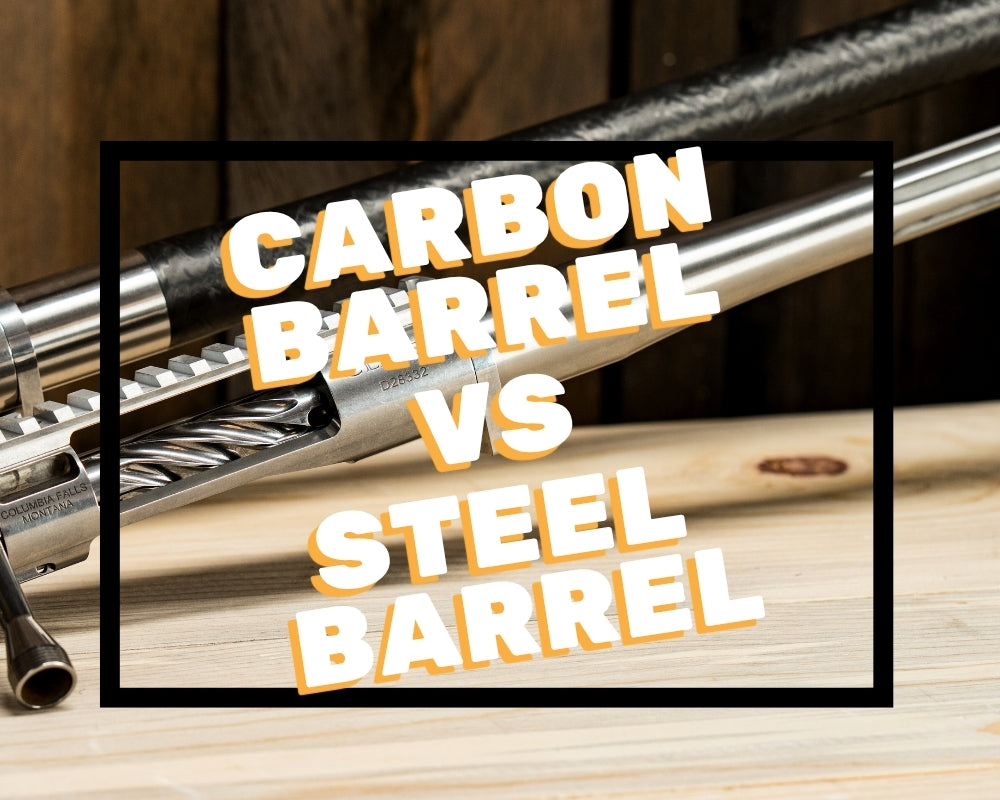
One of the most common questions we get when someone’s building a long-range rifle: carbon fiber barrel or steel barrel? The answer used to be easy — you got steel because that’s what existed. Today, carbon fiber barrels are good enough that the choice actually matters, and the right answer depends on what you’re building the rifle for.
Here’s the quick Tip Tuesday version, then the full breakdown.
What a Carbon Fiber Barrel Actually Is
A “carbon fiber barrel” is a bit of a misnomer. The bore itself — the part the bullet rides through — is still steel. What’s different is the outside: a thin steel liner is wrapped in layers of carbon fiber, bonded under heat and pressure. The result is a barrel with the precision of a steel bore and the weight, stiffness, and heat properties of carbon.
The leader in this space is Proof Research, and their carbon barrels are what we run on most of our long-range hunting rifles for the reasons below.
Weight: The Headline Difference
This is the one most hunters care about. A typical 26” sporter-contour steel barrel weighs about 4.5–5 lbs. The same length and contour in carbon fiber comes in around 2.5–3 lbs.
That sounds small until you carry the rifle uphill at 9,000 feet. Two pounds off the front end of a hunting rifle changes how it handles, how fast you can get on target, and — over a long day — how well you shoot it. For backcountry hunters, this alone is the reason carbon exists.
Heat: Where Carbon Really Wins
Steel holds heat. After three or four shots in quick succession, a steel barrel is hot enough that the heat shimmer messes with your sight picture and the bore starts to walk your point of impact (this is called “walking” or “stringing”).
Carbon fiber dissipates heat much more efficiently than steel. The carbon wrap acts almost like a heat sink, pulling heat away from the steel liner and shedding it to the air. The practical result: you can shoot longer strings without the rifle losing its zero or its precision. If you’ve ever truing your data on a 10-shot group, you’ve felt the difference.
Stiffness and Accuracy
A common myth is that carbon fiber barrels are less accurate than steel. That hasn’t been true in years. A quality carbon barrel from a maker like Proof Research shoots every bit as well as a quality steel barrel — we’ve seen sub-half-MOA all-day from both.
If anything, the carbon wrap can make a thin barrel stiffer than a similar-weight steel pencil contour, which helps consistency.
Cost: The Steel Argument
This is where steel still wins. A premium steel barrel blank from Bartlein, Krieger, or Hart will run you $400–$700. The same quality in carbon fiber from Proof Research is roughly $1,200–$1,500. That’s real money on a build, especially if you’re assembling multiple rifles.
So Which One Should You Choose?
Pick Carbon Fiber If…
- You’re building a backcountry hunting rifle where every ounce matters
- You shoot longer strings at the range or in PRS-style competition and want to keep the barrel cool
- You want the premium build and the budget is there
Pick Steel If…
- You’re building on a budget and want the best accuracy per dollar
- The rifle lives mostly at the bench or on a tripod, where weight is irrelevant
- You’re on a chassis or heavy stock where the rifle is already heavy and the contour doesn’t change the balance
Where We Get Our Barrels
For carbon fiber, we run Proof Research barrel blanks on most of our long-range hunting builds. They’re available in the calibers and contours we use most:
- Proof Research .224 Cal — Sendero Contour
- Proof Research .243 (6mm) — Sendero Contour
- Proof Research .264 (6.5mm) — Sendero Contour
- Proof Research .284 (7mm) — Sendero Contour
- Proof Research .30 Cal — Sendero Contour
- Proof Research .338 Cal — Sendero Contour
If you have questions about which barrel and contour fit your build, drop a comment on the Extreme Outer Limits channel — we read every one and they often turn into the next Tip Tuesday.
Steel still works. Carbon just works better when weight and heat are on the line.


Leave a comment
This site is protected by hCaptcha and the hCaptcha Privacy Policy and Terms of Service apply.